Jinguashi from Jiufen

Jinguashi (金瓜石) is the gold-mining village over Keelung Mountain from Jiufen. Buses 788, 965, 1062, and 856 run on from the Jiufen Old Street stop; on foot it is 1.7 km, mostly downhill. Its Gold Museum (NT$80) holds a 220 kg gold bar and a mine tunnel; the Golden Waterfall lies on the road down.

Updated

At a glance

From Jiufen
Bus 788, 965, 1062, and 856Or 24 min on foot, at a flat-ground pace
Gold Museum
NT$80Closed on the first Monday of the month
Mine tunnel
NT$50About 180 m, extra ticket
Gold panning
NT$10020–30 min, a vial to take home
Gold bar
220 kgTouched through the glass
Golden Waterfall
FreeOpen all year
Allow
85 minThe museum's standard route

Is Jinguashi the same as Jiufen?

No. Jinguashi is a separate village of Ruifang District on the east side of Keelung Mountain. Jiufen lies on the west side, and the mountain is the boundary between them.

In 1894 prospectors found a gold outcrop shaped like a big pumpkin, jingua (金瓜) in Taiwanese, and the place took its name from it. In 1896 the Japanese authorities split the gold field at Keelung Mountain: the Jinguashi mine to the east went to the Tanaka group, and the Ruifang mine to the west, today's Jiufen, to the Fujita group.

The two towns stopped mining at different times. Gold mining in Jiufen ended in 1971. In Jinguashi it stopped in 1972, and the Taiwan Metal Mining Corporation closed in 1987.

History of Jiufen

Getting to Jinguashi from Jiufen

Four bus lines run on from the Jiufen Old Street stop to the Gold Museum, so the two towns fit into one day trip. On foot, a stairway path leads down the hill.

  • By bus

    Buses 788, 965, 1062, and 856 run from the Jiufen Old Street stop to the Jinguashi (Gold Museum) stop, 金瓜石(黃金博物館). The 1062 carries on to Quanji Temple, its last stop. The same lines run back to Jiufen, Ruifang and Taipei from the stop across the road.

    • 788
    • 965
    • 1062
    • 856
  • On foot

    1.7 km, 24 min on foot: along Qiche Road to Geding, down the Shanjian Road stairway (山尖路觀光步道), then lanes to the museum. The way back climbs the whole way and takes longer.

    • 1.7 km
  • By car

    Parking at the museum is limited. The museum sends drivers to the Quanji Temple parking lot, about 10 minutes' walk away. By the coast, the Shuinandong parking lot is free, with 300 spaces.

Jinguashi: the Gold Museum, Quanji Temple and the road down to the Yin Yang Sea.
  1. Jiufen Old Street bus stopWhere the buses to Jinguashi leave.
  2. Jinguashi (Gold Museum) bus stopThe stop for the museum.
  3. Gold BuildingThe gold bar and the tunnel.
  4. Crown Prince ChaletClosed for restoration.
  5. Gold ShrineThe shrine ruins above the museum.
  6. Quanji TempleThe temple and its parking lot.
  7. Baoshi Mountain viewpointThe lookout over the bay.
  8. Golden WaterfallFree, beside the road down.
  9. Thirteen LevelsThe smelter ruins.
  10. Yin Yang SeaThe two-colored bay.

The Gold Museum: tickets, the tunnel and the gold bar

The New Taipei City Gold Museum (新北市立黃金博物館) covers the old mine sites of Jinguashi and is closed on the first Monday of each month. Its standard route takes about 85 minutes, without the tunnel and gold panning. It opened in 2004.

Gold Museum tickets
TicketPrice
Entry to the museum parkNT$80
Benshan Fifth TunnelNT$50
Gold panningNT$100

The entry ticket is valid on the day of purchase only. The museum also closes on Lunar New Year's Eve, on the first day of the Lunar New Year and on typhoon days.

Mining history and the gold bar

Gold Building (黃金館)

The former mining office of the Taiwan Metal Mining Corporation. The ground floor tells the history of the mines. Upstairs is the 220 kg gold bar, once certified by Guinness World Records as the largest in the world. Visitors touch it through small holes in the bulletproof glass.
Mine tunnel, extra ticket

Benshan Fifth Tunnel (本山五坑)

About 180 m of the old tunnel are open: 10 to 15 minutes on foot, in a helmet, at 18 to 22 °C all year. The tunnel is narrow, slopes slightly and may be wet. It has no step-free route, and high heels, slippers and sandals are not allowed.

Activity, extra ticket

Gold panning (淘金體驗)

You wash gold dust out of the ore and take home a vial of it, in about 20 to 30 minutes. Tickets are sold at the booth beside the Gold Building.

The Japanese-era sites

Inside the museum park and on the slope above it stand the houses and ruins of the Japanese mining town.

Staff housing

Four Joined Japanese Houses (四連棟)

Japanese staff dormitories, probably built in the 1930s by Nippon Mining and later lived in by Taiwan Metal Mining staff. The museum has furnished the rooms as homes of the period.

Closed for restoration

Crown Prince Chalet (太子賓館)

Built in 1922 for a visit by the Japanese crown prince, later Emperor Showa, who never came. It is Japanese in style with Western rooms, built of cypress joined without iron nails. Taipower is restoring it, and it is seen from the outside only.

Shrine ruins

Gold Shrine (金瓜石神社)

Completed probably in 1937 and destroyed after the war. The torii gates, a few stone lanterns and the foundations and pillars of the hall remain. The steps up from beside the light railway take 20 to 30 minutes, and the path goes on to the Jinguashi geopark, a former open-cast mine.

Memorial

Prisoner-of-war camp memorial

From 1942 the Japanese army held more than 500 Allied prisoners here, most of them from the Commonwealth, and made them mine copper. A memorial has stood on the site since 1997. The 856 and the 1062 stop at Guashan Elementary (POW camp), 瓜山國小(戰俘營).

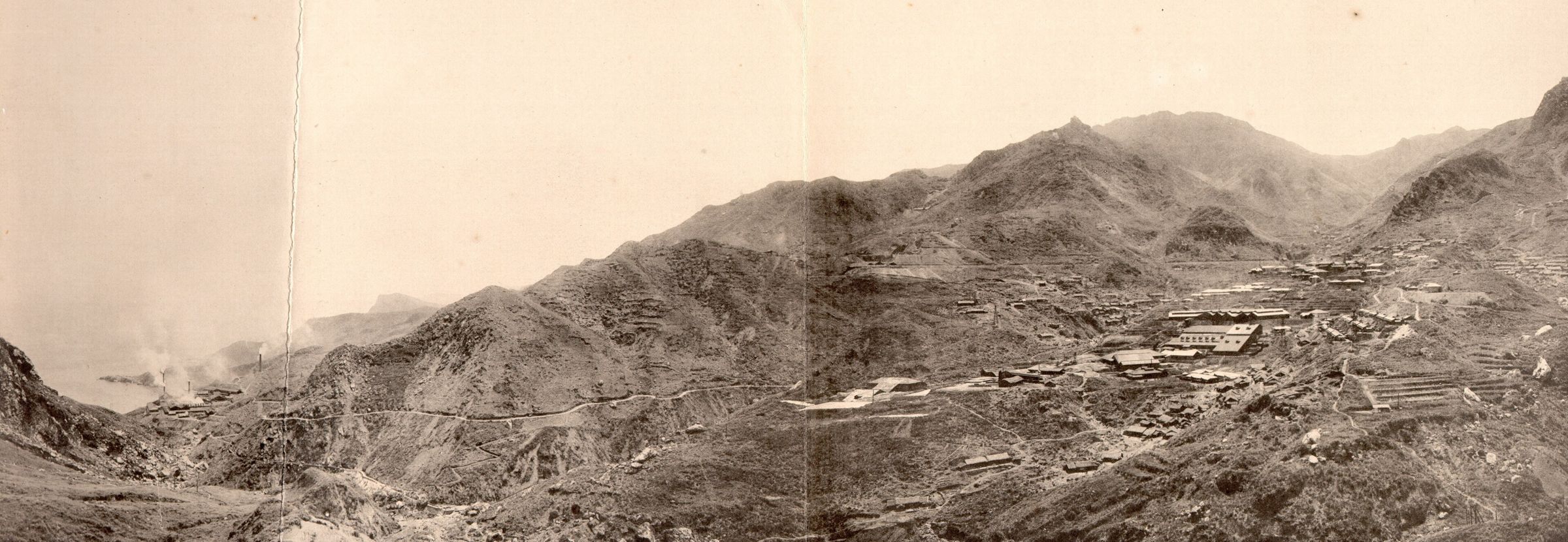
A black-and-white panorama of the Jinguashi mine and its hills in the Japanese era
The Jinguashi mine in the Japanese era.

The road down: Golden Waterfall, Thirteen Levels, Yin Yang Sea

Below the Gold Museum the road winds down to Shuinandong (水湳洞) on the coast. The 856 and some 788 buses go down, and the 856 carries on along the coast to Nanya and Bitou Cape. On foot the Golden Waterfall is 29 min on foot from Jiufen.

Free, open all year

Golden Waterfall (黃金瀑布)

About 1 km above Shuinandong, beside the Jinshui Road. Its water drains from the Benshan No. 6 and No. 7 mine tunnels. This acid mine water carries iron, which settles yellow on the rock where it meets the air. The smelter has nothing to do with it.

Smelter ruins, seen from afar

Thirteen Levels (十三層遺址)

The Shuinandong ore-dressing plant, built in 1933 in terraces down the slope. Work ended in 1987 and Taipower took it over. The ruins are seen from the Shuinandong parking lot or from the Changren community. The disused flues run 2 km over the hill above.

The two-colored bay

Yin Yang Sea (陰陽海)

The bay north of Shuinandong is yellow-brown near the shore and blue further out. The hills of Jinguashi are rich in pyrite, and as the rock weathers, iron hydroxide hangs in the water and colors it. Much of it is natural weathering: the color was there before the mining company and stayed after it closed.

Quanji Temple, Qitang Road and Baoshi Mountain

Above the museum, Qitang Road (祈堂路) climbs to Quanji Temple, the last stop of the 1062, with a lookout beside its parking lot.

Temple

Quanji Temple (勸濟堂)

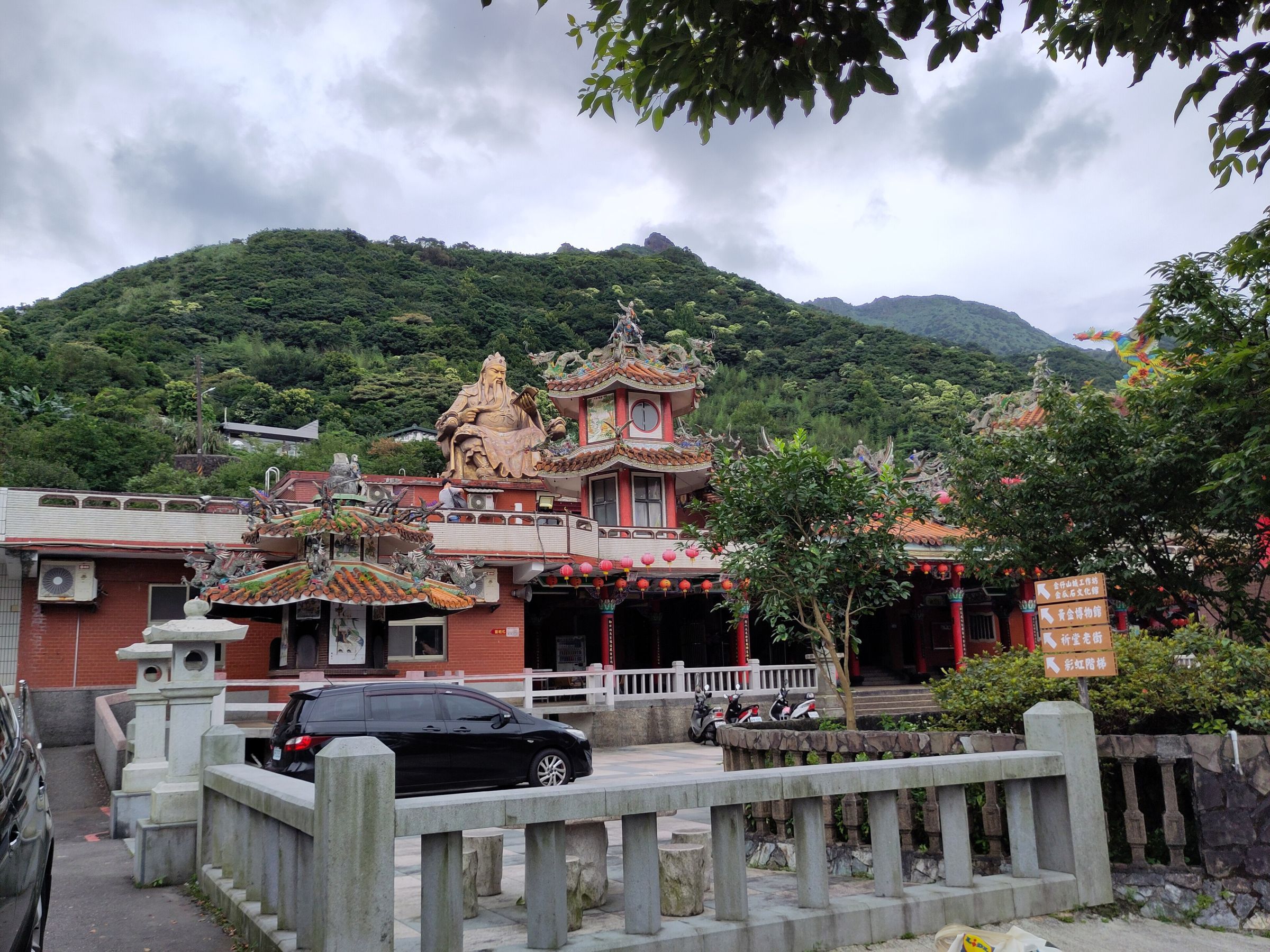
A temple to Guan Gong on Qitang Road. Its bronze statue of Guan Gong weighs 25 tonnes.

Viewpoint

Baoshi Mountain viewpoint (報時山)

From the Gold Building it is 10 to 15 minutes on foot to the Quanji Temple parking lot, then 5 to 10 minutes to the end of the trail. The view takes in the Yin Yang Sea, the smelter ruins and their flues, Keelung Mountain, Teapot Mountain and Jinguashi.

Trail closed in October 2024

The peak shaped like a teapot over Jinguashi. Its trail starts beside the museum or behind Quanji Temple, and it closed in October 2024, after landslides from Typhoon Krathon. Ask before you go.

Quanji Temple in Jinguashi, with a green hill behind
Quanji Temple, above the Gold Museum.

Eating and staying in Jinguashi

Jinguashi sells the miner's lunchbox (礦工便當): a steel lunchbox wrapped in a cloth printed with a map of Jinguashi.

Café, the miner's lunchbox

Miners Café & Restaurant

In the former telephone switchboard room of the Taiwan Metal Mining Corporation, at No. 8-1 Jinguang Road.

Restaurant

Shi Bu Yan (食不厭)

On the winding road between Jiufen and Jinguashi, at No. 221 Jinguang Road.

Restaurant

Lao Kuanggong Shitang (老礦工食堂)

In Jinguashi, at No. 72-1 Qitang Road.

Jinguashi has guesthouses of its own along Qitang Road and Shanjian Road, among the places to stay around Jiufen.

Frequently asked questions

How much is the Gold Museum ticket?

Entry to the Gold Museum costs NT$80 and is valid on the day of purchase only. The Benshan Fifth Tunnel costs NT$50 more and gold panning NT$100. The museum is closed on the first Monday of each month. The Golden Waterfall below it is free and open all year.

Can you pan for gold in Jinguashi?

Yes, at the Gold Museum. You wash gold dust out of the ore yourself and take a vial of it home, in about 20 to 30 minutes. It costs NT$100, on top of the NT$80 entry ticket, and tickets are sold at the booth beside the Gold Building.

Can you touch the gold bar at the Gold Museum?

Yes. The 220 kg bar on the upper floor of the Gold Building lies behind bulletproof glass with small holes on both sides, and visitors reach through them to touch it. Guinness World Records once certified it as the largest gold bar in the world.

Why is the Golden Waterfall golden?

Its water drains from two old mine tunnels, Benshan No. 6 and No. 7. It is acid mine drainage: when the iron in it meets the air, it oxidizes and settles on the rocks in yellow and orange. The smelter at Shuinandong has nothing to do with it.

How long should you spend in Jinguashi?

The Gold Museum's standard route takes about 85 minutes. The tunnel adds 10 to 15 minutes and gold panning 20 to 30. The walk up to the Gold Shrine takes another 20 to 30 minutes, and the Golden Waterfall and the Yin Yang Sea are a bus ride further down.